Top 12 In-Demand Healthcare Jobs of 2026: Salaries & How to Start
Explore the 12 most in-demand healthcare jobs of 2026, with real salary data, required qualifications, hiring trends, and actionable steps to break in or level up.

Top 12 In-Demand Healthcare Jobs of 2026: Salaries & How to Start
Healthcare isn't just a growth industry right now. It's single-handedly carrying the U.S. labor market.
In early 2026, healthcare accounted for 81,900 of the 130,000 total jobs added, roughly 63% of all employment gains, at a time when most other sectors were sluggish. The sector is projected to generate approximately 1.9 million job openings per year over the next decade. If you're weighing a career move or wondering where stable, well-paying work actually lives in 2026, the answer is increasingly: healthcare.
This guide breaks down the 12 most in-demand roles, what they actually pay, what it takes to get hired, and how to start moving toward one today.
Why healthcare is dominating hiring in 2026

Three forces are driving this surge, and none of them are going away.
Demographics. Baby boomers now make up roughly 20% of the U.S. population, and all of them are Medicare-eligible. The oldest boomers are in their late 70s, the age bracket where healthcare utilization spikes sharply. More patients needing more care, continuously, is the baseline reality every hiring manager is working against.
A deepening worker shortage. According to the 2026 Indeed Pulse of Healthcare report, 2 in 5 healthcare workers say their jobs feel "unsustainable," and 1 in 4 are considering leaving the field entirely by year-end. By late 2026, the U.S. is projected to face a 4.6-million worker gap in support roles alone, covering medical assistants, pharmacy technicians, and similar positions. Meanwhile, 60% of non-clinical hiring managers report that finding skilled professionals is harder than it was a year ago.
A structural shift in where care happens. Ambulatory healthcare services added 50,300 jobs in early 2026 alone, with physician offices (17,800 jobs), home health services (17,100), and outpatient care centers (3,700) driving that growth. Care is moving out of hospitals and into communities, and jobs are following.
The result: employers are moving fast. 75% of healthcare hiring managers plan to increase permanent headcount in the second half of 2026, and 69% expect to bring on more contract and temporary talent.
The 12 most in-demand healthcare jobs of 2026
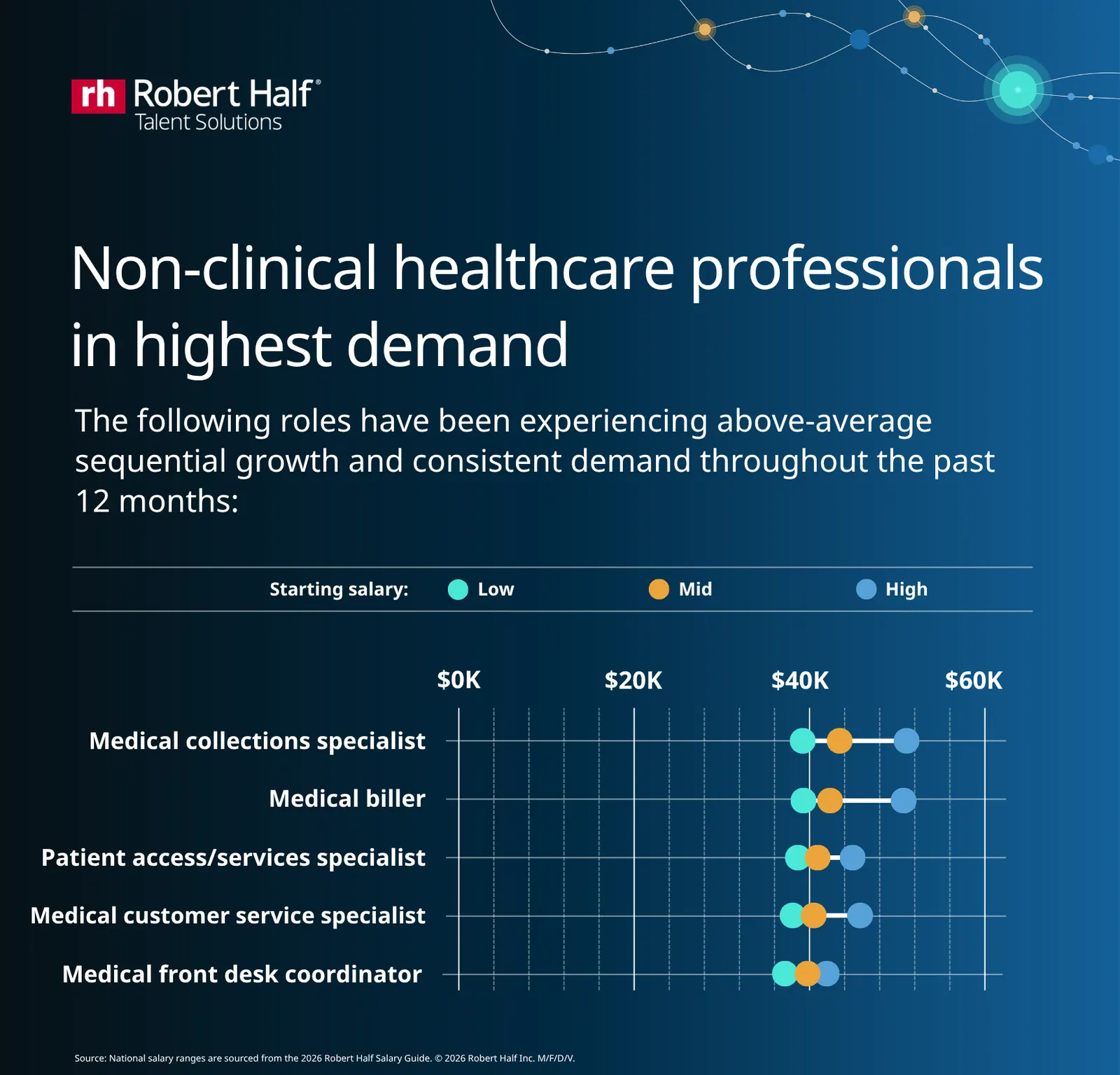
Below is a snapshot of the roles commanding the most attention from employers right now, and why each one is surging.
- Nurse Practitioner (NP), Advanced practice clinician providing primary and specialty care; projected 40.1% employment growth through 2034.
- Registered Nurse (RN), Core clinical caregiver across hospitals, clinics, and home settings; 189,100 average annual openings projected through 2034.
- Physician Assistant (PA), Diagnoses, treats, and manages patients under physician oversight; growing alongside NPs to fill the physician gap.
- Medical Assistant (MA), Handles both clinical and administrative tasks in physician offices and outpatient settings; demand is exploding as ambulatory care expands.
- Home Health Aide / Personal Care Aide, Provides daily living support and basic health monitoring to elderly and disabled patients at home.
- Physical Therapist (PT), Rehabilitates patients recovering from injury, surgery, or chronic conditions; aging population and sports medicine demand are both rising.
- Occupational Therapist (OT), Helps patients regain functional independence; pediatric and geriatric caseloads are both growing.
- Pharmacy Technician, Assists pharmacists with dispensing medications; one of the most acute shortage roles cited in the 4.6-million worker gap projection.
- Surgical Technologist, Prepares operating rooms and assists during procedures; among the most difficult hospital roles to staff in 2026.
- Medical and Health Services Manager, Plans, directs, and coordinates health services at the facility or department level; demand accelerates as systems grow more complex.
- Telehealth Coordinator / Digital Health Specialist, Supports virtual care delivery, patient scheduling, and remote monitoring platforms; a newer role created directly by the shift to tech-enabled care.
- Diagnostic Medical Sonographer / Imaging Technologist, Operates imaging equipment for diagnosis; tight supply makes this one of the most competitive specialties for employers to fill.
Realistic salary ranges in 2026
Salaries vary significantly by role, experience, geography, and care setting. Rural and non-metropolitan markets are facing the deepest shortages, and the same credentials can command meaningfully higher pay when you're willing to go where demand is highest.
| Role | Entry-Level | Mid-Career | Experienced/Senior |
|---|---|---|---|
| Nurse Practitioner | ~$100,000 | ~$129,210 (median) | $150,000+ |
| Registered Nurse | ~$65,000 | ~$97,550 (median) | $115,000+ |
| Physician Assistant | ~$95,000 | ~$126,000 | $145,000+ |
| Medical Assistant | ~$35,000 | ~$42,000 | ~$52,000 |
| Home Health Aide | ~$28,000 | ~$33,000 | ~$40,000 |
| Physical Therapist | ~$75,000 | ~$97,000 | $115,000+ |
| Occupational Therapist | ~$72,000 | ~$93,000 | $110,000+ |
| Pharmacy Technician | ~$32,000 | ~$40,000 | ~$52,000 |
| Surgical Technologist | ~$48,000 | ~$60,000 | ~$75,000 |
| Health Services Manager | ~$72,000 | ~$110,000 | $145,000+ |
| Telehealth Coordinator | ~$45,000 | ~$62,000 | ~$85,000 |
| Diagnostic Sonographer | ~$60,000 | ~$80,000 | ~$100,000 |
Quick note on location: California, New York, Oregon, Massachusetts, and Washington are the highest-paying states for advanced practice nurses. Travel and contract roles, especially for RNs and surgical techs, can push total compensation significantly above these figures, often by 30-50%.
Required qualifications and skills
What you need depends heavily on the role. Here's how to think about it in two tiers.
Clinical and advanced practice roles
- Nurse Practitioner: BSN → RN licensure → MSN or DNP → board certification (ANCC or AANP)
- Registered Nurse: ADN or BSN → NCLEX-RN licensure
- Physician Assistant: Bachelor's degree → accredited PA program (typically a master's) → PANCE certification
- Physical Therapist / Occupational Therapist: Bachelor's in relevant science → DPT (PT) or MOT/OTD (OT) → state licensure
- Diagnostic Sonographer: Associate's or bachelor's in sonography → ARDMS credential
Support, technical, and administrative roles
- Medical Assistant: Postsecondary certificate (1-2 years) → optional CMA or RMA certification (increasingly expected)
- Pharmacy Technician: High school diploma plus on-the-job training → PTCB or ExCPT certification (required in many states)
- Surgical Technologist: Associate's degree or certificate → CST credential through NBSTSA
- Health Services Manager: Bachelor's in health administration (entry) → MHA or MBA preferred for senior roles
- Telehealth Coordinator: Associate's or bachelor's degree plus EHR proficiency → no universal certification yet, but digital health credentials are emerging
- Home Health Aide: State-approved training program (varies by state, typically 75-120 hours)
What employers are consistently prioritizing in 2026 beyond credentials: Candidates who demonstrate digital fluency, specifically comfort with EHR platforms, telehealth tools, and basic data interpretation, are standing out. The ability to work across care teams matters just as much as individual clinical skill. Healthcare is operating under intense staffing pressure, which means adaptability, communication across disciplines, and low-drama reliability aren't soft skills. They're the baseline expectation.
Hiring trends reshaping healthcare in 2026
The headline numbers are impressive, but how healthcare is hiring is shifting just as fast as how many.
"AI is reshaping healthcare roles, but not replacing them." From patient scheduling to revenue cycle management and telehealth triage, AI tools are taking over routine tasks. Employers are increasingly seeking professionals who can work alongside these tools, not just despite them.
"Ambulatory and home care are where the jobs are being created." Physician offices and home health together accounted for nearly 35,000 of the new healthcare jobs added in early 2026. If you're targeting a clinical role and you're only looking at hospitals, you're looking in the wrong place.
"42 states now grant near-full practice authority to Nurse Practitioners." This regulatory shift is accelerating NP hiring as health systems use team-based care models to manage the physician shortage. The AAMC projects a gap of up to 86,000 physicians by 2036.
One more trend worth noting: contract and travel roles are no longer a backup plan. With 69% of hiring managers planning to expand temporary and contract talent in the second half of 2026, structured short-term work is a real pathway to test a specialty, build your resume, and command premium pay, especially if you're willing to work in high-need rural areas.
Healthcare-specific resume and interview tips
Generic resume advice won't cut it here. Here's what actually moves the needle in healthcare hiring.
Lead with your licensure and certifications, right at the top. Healthcare hiring managers screen for credentials before they read anything else. Put your RN, NP-C, PA-C, CMA, or equivalent credential directly in your name line or professional summary. Don't bury it.
Quantify your patient load, not just your duties. Weak: "Provided patient care in a busy ED." Strong: "Delivered care for 12-15 patients per shift in a Level II trauma ED, including triage, medication administration, and discharge planning." Numbers make your experience real and comparable.
Mirror the job posting's clinical language. ATS systems in healthcare are calibrated for specific terminology: "electronic health records," "patient assessment," "care coordination," "HIPAA compliance." If the posting uses those phrases and your resume doesn't, you may not make it past the initial scan.
For support and administrative roles, name your EHR platform experience explicitly. Epic, Cerner, Meditech, Athenahealth. Employers often filter for these directly.
Prepare for behavioral and situational interview questions, not just clinical ones. Healthcare interviewers in 2026 are heavily focused on how you perform under staffing pressure, how you communicate across care teams, and how you handle ethical dilemmas. Have a STAR-format answer ready for: "Tell me about a time you had to advocate for a patient" and "Describe how you managed a conflict with a colleague during a high-pressure situation."
Don't underestimate the cultural fit question. High turnover rates mean hiring managers are acutely attuned to burnout risk. Be ready to speak genuinely about how you manage stress, sustain your own wellbeing, and stay motivated in a demanding environment, without sounding like you're reciting a script.
Is healthcare the right move for you?
Not every high-growth sector is the right fit for every job seeker. Use this quick checklist to self-qualify honestly.
You're likely a strong fit if you:
- Find genuine meaning in helping others through difficult moments
- Can stay calm and methodical when stakes are high
- Are comfortable with ongoing learning: licensing requirements, continuing education, and evolving tools don't frustrate you
- Are physically and emotionally resilient (clinical roles especially)
- Want job security and are willing to invest in credentials to get it
- Are open to non-hospital settings: clinics, home care, telehealth, outpatient
Pause and think if you:
- Are primarily motivated by the salary and haven't spent time in a care environment
- Struggle with shift work, irregular hours, or being on your feet for extended periods (clinical roles)
- Want full remote flexibility. Most clinical roles require physical presence, though admin and coordination roles are more flexible
- Are in a hurry. Credential pathways range from 1 year (MA, home health aide) to 6-8 years (NP, PT, PA)
The good news: healthcare has a role for almost every timeline and temperament. Entry-level support roles can get you earning within a year. Advanced practice roles take longer but offer some of the highest job security and compensation in any profession.
Your next steps to break in or level up
Pick one of these and do it this week, not when you feel ready.
Identify your target role and its credential path. Use the qualification breakdown above to map your current education to the shortest realistic route to your goal role. Many paths stack: an MA certification puts you in clinical settings immediately while you complete an RN program.
Search accredited programs in your state. For clinical roles, accreditation is non-negotiable. Employers and licensing boards check it. Use the ACEN, CCNE (nursing), ARC-PA (physician assistant), or CAAHEP (allied health) directories to verify.
Target ambulatory and outpatient employers first. Physician offices, urgent care networks, home health agencies, and outpatient rehab centers are where hiring volume is highest in 2026. Don't limit your search to hospitals.
Build or refresh your healthcare resume with credentials front and center. Even if you're still in school, clinical hours, externships, and software experience (Epic, Cerner) belong on your resume now. Every relevant touchpoint counts.
Explore contract and travel roles if you're already credentialed. If you hold an active RN, surgical tech, or imaging credential, travel staffing agencies can place you within weeks, often at premium rates in high-need markets. This is one of the fastest ways to build experience and income at the same time in 2026.
Set a 90-day credential or application milestone. The biggest stall in career transitions is vague intention. Decide by the end of this week: are you applying to programs, sitting for a certification exam, or submitting applications? Put a date on it.
Healthcare isn't waiting for talent to find it. It's actively recruiting. The question is whether your next move positions you to meet it.
Editor's Picks
 News
News 57,000 Jobs Added: How to Get Hired in the 2026 Slowdown
Jul 10, 2026
 Interviews
 Ace Your AI Video Interview in 2026: HireVue Tips & Prep Guide
Jul 10, 2026
 Resume
 Beat AI-Powered ATS in 2026: What Your Resume Must Do Now
Jul 10, 2026
 Skills
 Best AI Skills to Put on Your Resume in 2026 (Get Hired Fast)
Jul 10, 2026