Top Cybersecurity Skills & Certs to Land a Job in 2026 — No Degree Needed
Discover the top cybersecurity skills and certifications to land a job in 2026 — no degree required. Actionable roadmap for every career stage.

Top cybersecurity skills & certs to land a job in 2026, no degree needed
Cybersecurity has 514,000+ open U.S. jobs in 2026, and employers are actively hiring candidates who can prove their skills, no degree required.
The market signal is about as clear as it gets. While tech layoffs have gutted software development and data analytics hiring, cybersecurity job postings have climbed past 514,000 in the U.S. alone, making security the only major tech sector still posting above pre-pandemic hiring levels. Globally, there are an estimated 4.8 million unfilled cybersecurity roles. If you've been waiting for the right moment to break in or pivot, the conditions are better right now than they've been in years.
Why the "no degree" path is genuinely viable now

This isn't a motivational pitch. Research from ISC2 shows that 90% of hiring managers would consider candidates with only IT work experience, and 70% value entry-level experience over a bachelor's degree for junior positions. The industry's shift toward skills-based hiring is real and measurable.
Here's the catch: "no degree needed" does not mean "no proof needed." The market no longer rewards vague enthusiasm; it rewards narrow, demonstrable skill. Employers want candidates who have done the thing, not just studied it. Labs, simulations, practical exams, and portfolio projects have replaced the diploma as the primary credibility signal at the entry level.
What cybersecurity work actually looks like in 2026
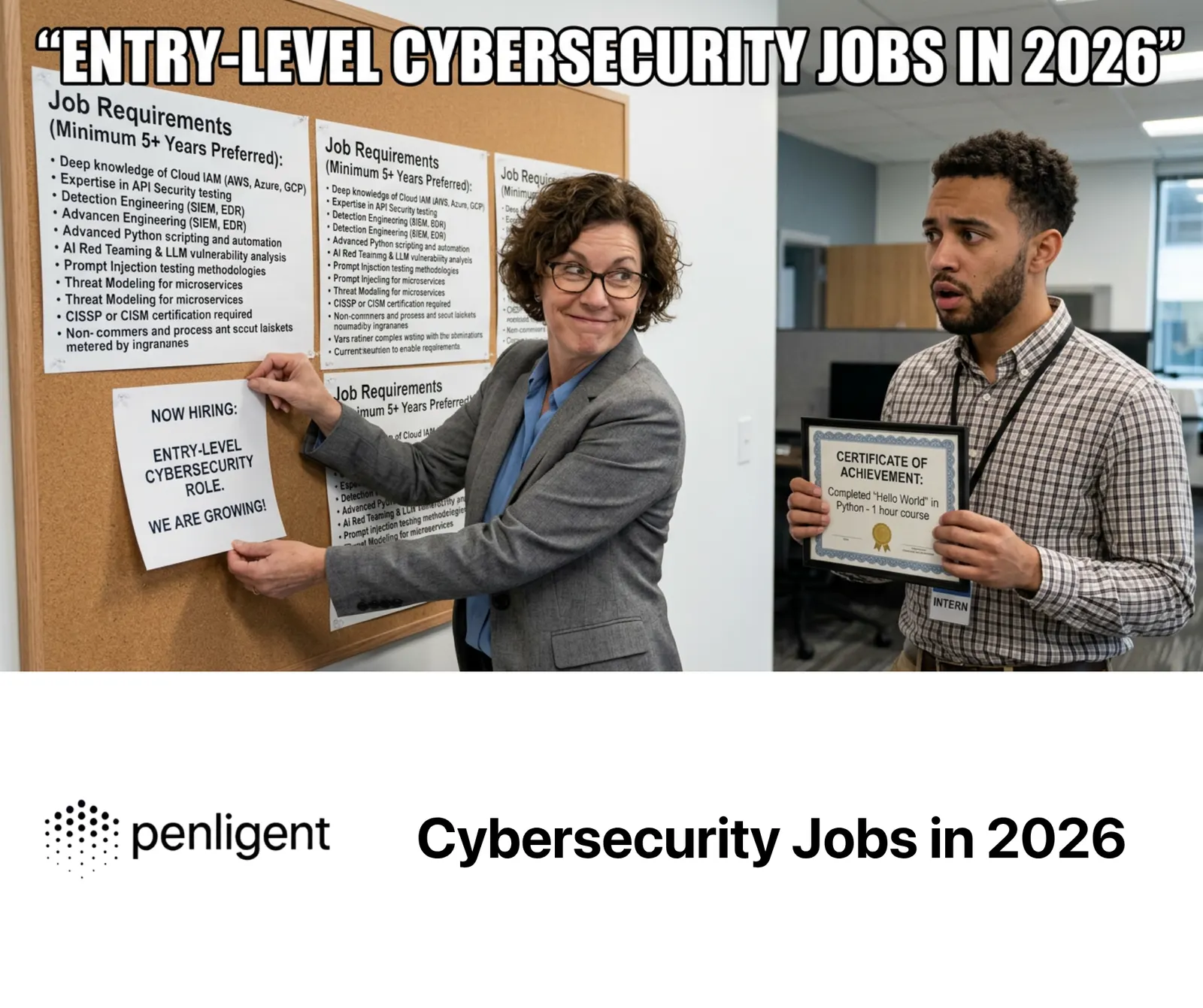
Before you map a learning path, get clear on what the job entails, because "cybersecurity" is not one role. It's a discipline spanning detection, response, architecture, compliance, and more.
In 2026, cybersecurity jobs focus less on "locking things down" and more on building resilient, adaptive security programs. That means understanding how systems fail, how attackers move through networks, and how to communicate risk to people who don't speak technical. The skill set is part engineer, part analyst, part communicator, and the balance shifts depending on your specialization.
What it is not: a purely defensive IT support role. Modern security work is proactive, analytical, and increasingly tied to business outcomes.
The technical skills employers are actively hiring for
Hiring signals in 2026 are specific. Here's where employer demand is concentrated, backed by job posting data and ISC2 industry surveys.
1. AI and machine learning security
Forty-one percent of cybersecurity employers now rank AI as the single most-needed candidate skill. Over 64% of cybersecurity job listings in 2026 specifically mention AI, machine learning, or automation capabilities, with roughly 10% listing AI skills as a hard requirement rather than a nice-to-have. The World Economic Forum's Global Cybersecurity Outlook 2026 found that 87% of respondents identified AI-related vulnerabilities as the fastest-growing cyber risk over the past year.
What this means practically: you don't need to build AI models. You need to understand how attackers exploit them, how to evaluate AI-generated security alerts, and how to use AI tools to automate detection workflows.
2. Cloud security
Cloud misconfigurations and weak identity controls remain a leading cause of security incidents. Organizations need professionals who can design security into AWS, Azure, and Google Cloud environments, not just operate security tools after the fact. ISC2 identifies cloud security as the second-most demanded skill behind AI/ML, and cloud security engineers earn significantly above the overall cybersecurity median salary.
3. Governance, risk & compliance (GRC)
GRC is seeing some of the highest demand growth as global regulations tighten. To succeed here, candidates need a "T-shaped" skill set: broad business context with deep expertise in specific risk domains. Technical literacy is essential. Not writing code, but understanding how cloud environments, API integrations, and AI models fail, then translating that into policy and audit language.
4. Networking fundamentals & SIEM tools
Networking fundamentals remain the foundation for entry-level hiring. You need to understand how data moves across networks (TCP/IP, DNS, firewalls, routing) before you can detect anomalies in that traffic. Pair that with hands-on experience in a SIEM tool like Splunk or Elastic Stack, and you're speaking the language of most entry-level job descriptions.
5. Identity & access management (IAM) and zero trust
Zero trust architecture has moved from buzzword to buying standard. Employers want candidates who understand identity as the new perimeter: how authentication works, how privilege escalation happens, and how to design least-privilege access policies. IAM skills pair naturally with cloud security and are increasingly listed together in job postings.
6. Incident response & threat hunting
These skills have the fewest qualified practitioners and the highest employer urgency, which means less competition and stronger negotiating leverage if you build them. Incident response involves knowing exactly what to do when a breach happens: containment, investigation, root cause analysis, and documentation. Threat hunting is proactive, searching for attacker activity before an alert fires.
How to build these skills: a tiered roadmap
You don't need to learn everything at once. Work through this in order.
Beginner: build the foundation (months 1, 3)
- Start with Google's Cybersecurity Professional Certificate on Coursera. It covers networking, Linux, SQL, SIEM basics, and Python scripting, and it's specifically designed for career switchers with no prior experience. Most learners complete it in three to six months.
- Set up a home lab. Use free tools: VirtualBox or VMware (free tier), Kali Linux, and Metasploitable. Practice scanning, enumerating, and compromising a safe target. Document every step.
- Work through TryHackMe's "Pre-Security" and "SOC Level 1" learning paths. These are browser-based, beginner-friendly, and produce real skills in network analysis, SIEM usage, and threat detection.
Intermediate: specialize and certify (months 3, 8)
- Pursue CompTIA Security+. It remains the most widely recognized entry-level certification across government, defense contractors, and enterprise employers. Many U.S. federal roles require it by DoD 8570 directive.
- Add a cloud security track. If you're aiming at cloud roles, study for the AWS Certified Security, Specialty or Microsoft SC-900/AZ-500. These pair directly with cloud security job postings.
- Build a SIEM project. Use Elastic Stack's free tier or Splunk's free version. Forward logs from Windows and Linux VMs, write detection rules for common attack patterns like brute-force login attempts, and document your methodology. This becomes your portfolio centerpiece.
Advanced: high-paying specializations (months 8, 18)
- Pursue the CompTIA CySA+ or CASP+ if you're moving into analyst or senior roles.
- Earn the (ISC)² Certified in Cybersecurity (CC). It's free for one million candidates through ISC2's workforce initiative and signals commitment to the profession.
- Target OSCP (Offensive Security Certified Professional) if penetration testing is your goal. It's the most respected offensive security certification on the market and requires passing a 24-hour hands-on exam with no multiple choice.
- For GRC paths, pursue the ISACA CISA or CRISC. These are highly valued by enterprises and consulting firms and don't require a technical background to start.
The certifications that actually move the needle, by stage
Here's a quick-reference breakdown:
| Career stage | Certification | Best for |
|---|---|---|
| Entry level | Google Cybersecurity Certificate | Career switchers, first job |
| Entry level | CompTIA Security+ | Broad employer recognition, federal roles |
| Entry level | ISC2 CC (free) | Signal of professional commitment |
| Mid level | CompTIA CySA+ | SOC analyst, detection engineering |
| Mid level | AWS Security Specialty / AZ-500 | Cloud security roles |
| Advanced | OSCP | Penetration testing, red team |
| Advanced | ISACA CISA / CRISC | GRC, audit, risk management |
Every certification above has a self-study path. None requires a degree as a prerequisite.
How to demonstrate these skills to employers
Skills on a resume only work if they're connected to outcomes. Here's the difference between weak and strong:
Weak: "Familiar with cybersecurity tools and network monitoring."
Strong: "Built a home SIEM lab using Elastic Stack; wrote 12 detection rules for brute-force and lateral movement patterns; documented findings in a GitHub repository reviewed by 200+ peers."
The second version proves capability. Use this framework for every skill you list:
- What you used (tool, platform, framework)
- What you did (specific action)
- What it produced (result, output, or artifact)
For your resume
- List certifications in a dedicated section near the top, above work history if you're entry level.
- Include your home lab and personal projects as experience. Title the section "Projects" or "Cybersecurity Lab Work."
- Use keywords directly from job postings: "SIEM," "threat detection," "incident response," "cloud security," "IAM." ATS systems filter on exact matches.
For interviews
Use the STAR format (Situation, Task, Action, Result) even for lab projects. "I noticed my home SIEM was missing lateral movement detection, so I researched Windows Event IDs, wrote a custom rule, tested it against a simulated attack, and caught the activity within two minutes" is a real answer that beats "I'm passionate about cybersecurity."
Quick self-assessment: where do you stand?
Answer these honestly to identify your next move:
- Can you explain what happens when you type a URL into a browser, all the way through to page load?
- Can you set up a Linux VM and navigate it from the command line?
- Have you ever used Wireshark or a packet capture tool, even in a lab?
- Do you hold at least one recognized cybersecurity certification?
- Have you built, documented, and published at least one hands-on project?
- Can you explain what a SIEM does and name two use cases for detection rules?
- Do you understand the difference between authentication and authorization?
0, 2 checked: Start with the Google Cybersecurity Certificate and TryHackMe's beginner paths. Build the foundation before spending money on exams.
3, 4 checked: You're ready for CompTIA Security+ and your first portfolio project. Focus on building something you can show.
5, 7 checked: Target your specialization (cloud, GRC, incident response, or offensive security) and pursue the mid-to-advanced certifications that match your chosen path.
What to do next
Pick one action from the list below and do it today. Not this week. Today.
- Enroll in the Google Cybersecurity Professional Certificate on Coursera if you're starting from scratch. It's the clearest on-ramp to your first job.
- Create a free TryHackMe account and complete your first room. It takes 30 minutes and gives you an immediate skill anchor.
- Rewrite one resume bullet using the What, Did, Produced framework above. One strong line beats a page of vague claims.
The Bureau of Labor Statistics projects 29% employment growth for information security analysts through 2034, with a 2024 median salary of $124,910. The window is wide open right now. The candidates who build demonstrable, specific skills now will be the ones filling those 514,000 open roles. Start today.
Editor's Picks
 News
News 57,000 Jobs Added: How to Get Hired in the 2026 Slowdown
Jul 10, 2026
 Interviews
 Ace Your AI Video Interview in 2026: HireVue Tips & Prep Guide
Jul 10, 2026
 Resume
 Beat AI-Powered ATS in 2026: What Your Resume Must Do Now
Jul 10, 2026
 Skills
 Best AI Skills to Put on Your Resume in 2026 (Get Hired Fast)
Jul 10, 2026