Indeed vs. Glassdoor 2026: Merger Impact on Privacy & Job Search
Indeed and Glassdoor are now one. Here's what the 2026 merger means for your privacy, your job search, and which platform to use — and when.

If you've been using Indeed and Glassdoor as two separate tools in your job search, that option is effectively gone.
In September 2025, parent company Recruit Holdings announced the full operational integration of Glassdoor into Indeed, cutting 1,300 U.S. jobs and ending the two platforms' years-long existence as independent sister brands. By April 20, 2026, every Glassdoor user who wanted continued access had to connect their account to Indeed. The platforms now share your profile data, your job listings, and (in ways that deserve a close read) your privacy expectations.
This article is for any job seeker who uses either platform in 2026 and wants to understand exactly what changed, what it means for their data, and how to get the most out of both tools without unnecessary risk. The upfront verdict: Indeed remains the stronger active job search engine; Glassdoor still offers unique employer insight, but the forced account merger introduces real privacy tradeoffs you should understand before you apply anywhere.
Indeed vs. Glassdoor 2026: At a glance
| Feature | Indeed | Glassdoor |
|---|---|---|
| Primary Use | Job discovery & applications | Employer research & reviews |
| Cost to Job Seekers | Free | Free (requires Indeed login) |
| Job Listings Volume | Massive, 31.57% job board market share | Powered by Indeed's listings |
| Account Requirement | Stand-alone Indeed account | Indeed account required (as of Apr 20, 2026) |
| Best For | High-volume search, ATS-friendly applying | Company culture vetting, salary intel |
| Biggest Limitation | Lower employer transparency | Account data now linked to Indeed |
| Review System | Indeed employer reviews | Glassdoor reviews, now cross-platform via Review Intelligence™ |
| Apply Method | Indeed Apply | Indeed Apply (on Glassdoor jobs too) |
| GDPR Risk | Moderate | Elevated, flagged by AIM Group |
What the merger actually changed, and what stayed the same
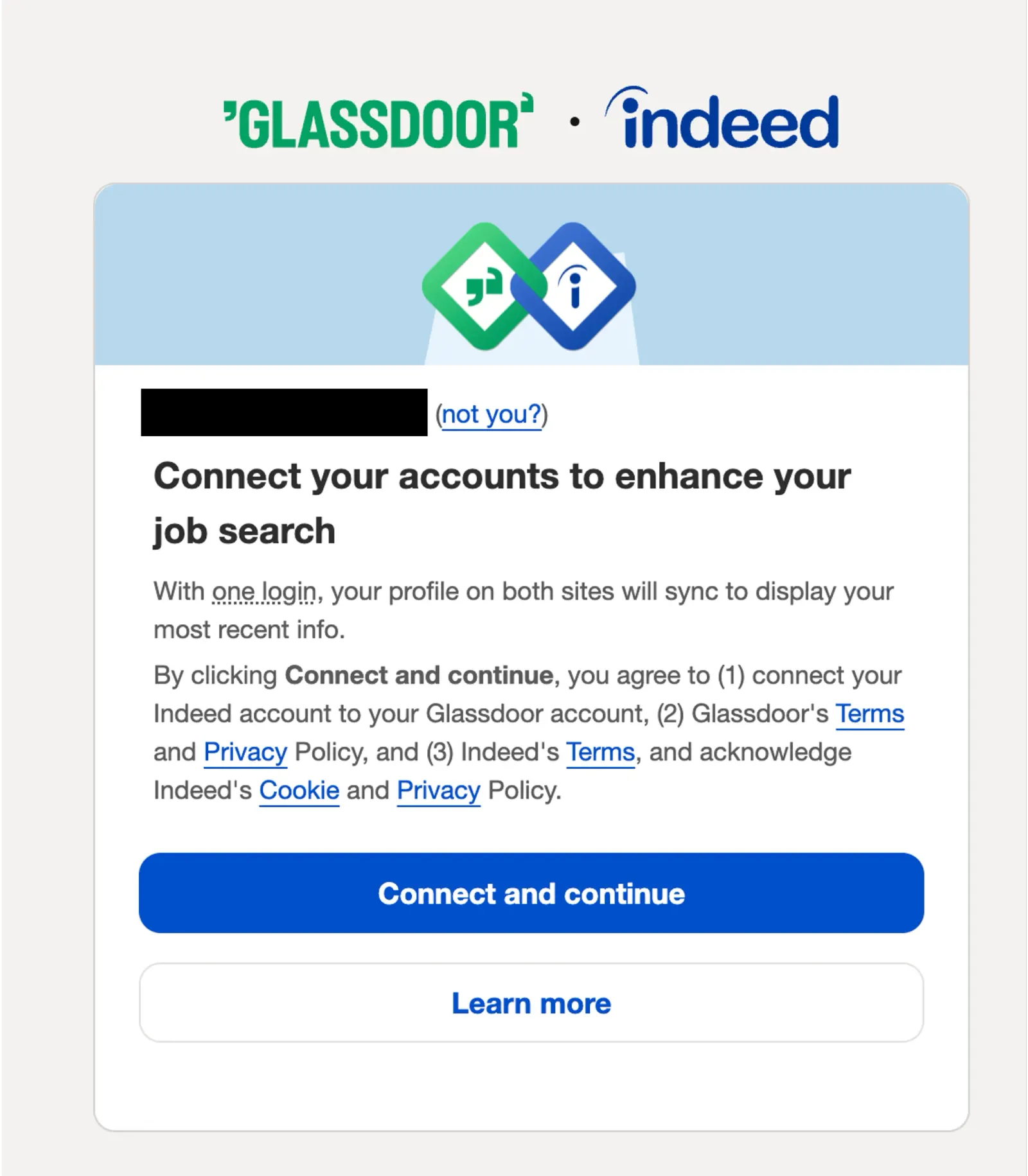
Accounts are now linked, permanently
This is the most consequential change for everyday job seekers. Starting November 18, 2025, new Glassdoor users were required to log in with an Indeed account. Existing users had until April 20, 2026 to either link their accounts or lose full platform access.
Once you link, the platforms create what they call a "Connected Profile", syncing your name, email, and resume across both Indeed and Glassdoor. Read this part twice: once you link your accounts, you cannot unlink them without deleting one of the accounts entirely. That is not a setting you can toggle off later.
Data deletion is also more complicated now. If you delete your Indeed account after February 4, 2026, your Glassdoor account still exists separately, meaning you'd need to delete both accounts individually to fully remove your data from the ecosystem. If privacy matters to you, that process requires deliberate action, not just clicking one "delete account" button.
Job listings are now unified
Organic job postings (non-sponsored listings) are shared across both platforms automatically. If a job appears on Indeed, it appears on Glassdoor. Updates, new postings, and removals sync in real time. For job seekers, this means you're no longer gaining a coverage advantage by checking both sites separately for organic listings.
Sponsored postings may still vary by placement, but the underlying job inventory is essentially the same pool.
Reviews are cross-platform too
Glassdoor and Indeed now feed into a combined system called Review Intelligence™, which extracts sentiment analysis and trends from reviews posted on both platforms. Employer ratings are consolidated for company branding purposes. In practice, the "company culture" data point you see on Glassdoor now draws from a larger, though unified, review set.
The core purpose of each platform is still different
Despite the integration, the two platforms serve distinct functions that haven't been collapsed.
- Indeed is built for discovery and application: searching, filtering, and submitting. It's a job search engine first.
- Glassdoor is built for employer intelligence: culture signals, salary data, interview experience reports, and CEO approval ratings.
Glassdoor does carry job listings, but they're powered by Indeed. Think of Glassdoor in 2026 as Indeed's employer-transparency layer, not a competing search engine.
The privacy picture: what you should know before you post a review
Anonymity isn't guaranteed
Indeed's support documentation states that your identity stays hidden when posting reviews or comments on Glassdoor. That's the official line. Glassdoor's own privacy policy is more candid, though: Glassdoor cannot guarantee user anonymity, noting that depending on the circumstances and information disclosed, someone may be able to identify a user or narrow their identity down to a small group of people.
That caveat existed before the merger. What's new is the stakes. When a review was posted from a standalone Glassdoor account, the identity linkage was limited. Now that your name, email, and resume are synced into a Connected Profile spanning both platforms, the surface area for potential identification is larger, even if the mechanics of review anonymity haven't formally changed.
If you're considering posting a candid review of a current employer, that's a risk worth weighing carefully.
Pre-existing trust problems got worse
The merger didn't create Glassdoor's trust deficit. It inherited one. In March 2024, TechCrunch reported that Glassdoor had added real names to user profiles without consent, triggering a wave of account deactivations. A LinkedIn poll conducted around that time found 90% of respondents said they don't trust Glassdoor. The forced account consolidation has done little to rebuild that confidence.
Steven Rothberg, founder of College Recruiter, put it plainly after the consolidation: "I think that the big lesson here is how callously some in our industry treat the data entrusted to us."
If you're based in the EU, pay attention
The AIM Group has flagged concerns that Glassdoor's data-sharing practices, particularly the cross-platform profile syncing, may breach GDPR and other regional data privacy regulations. If you're a job seeker in the EU, UK, or any jurisdiction with strong data protection laws, you have the right to request data access or deletion. Exercise it if you have concerns. Don't assume the platform manages your cross-border data compliance automatically.
What each platform still does best in 2026
Indeed: use it for active job searching
Indeed has been one of the world's largest job search engines since its launch in 2004. Its aggregation model, pulling listings from company websites, agencies, and boards, gives it unmatched volume. With a 31.57% job board market share, it remains the default starting point for most job seekers worldwide.
Where Indeed wins:
- Raw volume of listings across industries, experience levels, and geographies
- Indeed Apply: a fast, resume-on-file application flow that reduces friction
- Salary comparison tools and job market trend data
- Mobile experience and job alert customization
- Resume hosting that makes you discoverable to recruiters
Where Indeed falls short:
- Minimal employer culture transparency on its own
- Sponsored listings can crowd out organic results in competitive fields
- No verified employee review depth outside of what's now pulled from Glassdoor
Glassdoor: use it for employer intelligence
Glassdoor's value hasn't changed: it gives you a window into what it's actually like to work somewhere before you apply or accept an offer. Salary ranges, interview question reports, culture ratings, and CEO approval scores are still Glassdoor's strongest differentiators, and they now draw from a larger combined review pool thanks to the Indeed integration.
Where Glassdoor wins:
- Employer culture ratings and qualitative review depth
- Salary data and compensation benchmarks by role and location
- Interview experience reports: what questions were asked, how long the process took
- CEO approval ratings and company direction sentiment
- "Know Your Worth" salary negotiation tool
Where Glassdoor falls short:
- Job listings are entirely Indeed-powered, with no independent listing database
- Privacy concerns around the Connected Profile model
- Trust damage from past transparency issues that the merger hasn't repaired
Optimization tactics: getting the most from both platforms in 2026
On Indeed
- Complete your resume profile to 100%. Indeed's algorithm surfaces candidates based on profile completeness; gaps in work history, skills, or education reduce your discoverability.
- Turn on "Actively Looking" status. This signals to recruiters that your profile is open to outreach without publicly broadcasting your job search to your current employer.
- Set targeted job alerts, not broad ones. Alerts scoped to specific job titles, locations, and salary ranges surface higher-quality matches than generic keyword alerts.
- Use Indeed Apply where available. Applications submitted via Indeed Apply are processed faster and have lower drop-off rates; employers see them immediately in their dashboard.
- Add skills keywords that match your target roles. Indeed's search algorithm uses skills tags directly, so match the language in job descriptions, not just your internal job titles.
On Glassdoor
- Research every employer before applying, not after. Read both Glassdoor reviews and Indeed reviews (now cross-referenced in Review Intelligence™) to get a fuller culture picture.
- Check interview reports for your specific role. Filter by job title, not just company, to find reviews from people who interviewed for the same position you're targeting.
- Use salary data as a negotiation baseline, not an absolute. Glassdoor salary ranges can skew toward self-reported figures; cross-reference with LinkedIn Salary and Bureau of Labor Statistics data.
- Post your own review after interviews or departures. The more people contribute, the more useful the platform becomes, and anonymity, while imperfect, still provides meaningful cover for honest feedback.
- If privacy is a concern, use a dedicated email for your Connected Profile. Since account linking is now required, consider registering with an email address you use specifically for job searching, separate from your primary personal or work email.
Who should use each platform, and who should skip
Use Indeed if...
- You're actively job searching and want maximum listing volume
- You're in a role or industry where job postings are abundant (tech, healthcare, finance, retail, logistics)
- You want a fast, frictionless application process via Indeed Apply
- You're open to being found by recruiters via your resume profile
Use Glassdoor if...
- You're evaluating an offer or researching a company before an interview
- You want to benchmark your salary before negotiating
- You're trying to assess company culture or leadership before committing
- You're a passive candidate who wants intelligence, not volume
Skip Glassdoor's job search function entirely. Since its listings are entirely Indeed-powered, searching for jobs on Glassdoor adds no coverage advantage over searching directly on Indeed. Use Glassdoor as a research companion after you find a role on Indeed or elsewhere, not as a parallel job board.
Be cautious if you value strict separation between your job search identity and your anonymous reviews. The Connected Profile model makes that separation harder to maintain in 2026 than it was in prior years.
A real-world workflow: from search to informed application
Use this sequence to combine both platforms effectively in 2026:
- Start on Indeed. Set up a complete profile, activate job alerts for your target titles, and begin applying via Indeed Apply to roles that match your criteria.
- Before any application, open Glassdoor. Search the company name and read recent reviews (within the last 12 months) filtered to your department or role type.
- Check the interview reports. Look for your specific job title. Note what questions came up, how many rounds interviewers conducted, and whether candidates reported a fair process.
- Pull salary data. Use Glassdoor's range plus one external source (LinkedIn Salary, Levels.fyi for tech, or BLS for regulated industries) to build a negotiation range you can defend.
- Decide with context. A role with strong compensation and poor culture reviews deserves a different risk calculation than a role with great culture and average pay. You now have data to make that call before the first interview.
- After any significant interview experience, leave a review. It only takes a few minutes and directly helps other job seekers, including people in situations very similar to yours.
FAQ
Does linking my Indeed and Glassdoor accounts affect my anonymity when posting reviews?
Yes, in a meaningful way, even if the platform says otherwise. Indeed's documentation states that your identity remains hidden when posting reviews, but Glassdoor's own privacy policy acknowledges it cannot guarantee anonymity. With your name, email, and resume now synced in a Connected Profile, the risk of identification (particularly if your review contains specific operational details) is higher than when the accounts were separate.
Can I unlink my Indeed and Glassdoor accounts if I change my mind?
No. Once you connect the two accounts, the only way to unlink them is to delete one of the accounts. Deleting your Indeed account after February 4, 2026 does not automatically delete your Glassdoor account; you'd need to delete both separately to fully remove your data from each platform.
Are Glassdoor job listings different from Indeed listings in 2026?
No, they're effectively the same pool. Organic (non-sponsored) job listings are shared automatically across both platforms. Searching for jobs on Glassdoor gives you no independent listing coverage beyond what's already on Indeed. Use Glassdoor for employer research; use Indeed for job discovery.
Is Indeed still the best job board to use in 2026?
For most job seekers, yes, as a starting point. Indeed's scale, aggregation model, and 31.57% market share make it the highest-volume job search engine available. That said, no single platform should be your only channel. Pair Indeed with LinkedIn for networking-driven opportunities and Glassdoor for employer due diligence.
What are my rights if I'm a job seeker in the EU concerned about Glassdoor's data practices?
You have the right to access, correct, and delete your data under GDPR. The AIM Group has flagged concerns that Glassdoor's cross-platform data sharing may conflict with EU data protection law. If you're based in the EU or UK, you can submit a data subject access request (DSAR) directly to Glassdoor/Indeed and request an accounting of what data they hold and how it's shared. If you don't receive a satisfactory response within 30 days, you can escalate to your national data protection authority.
The Indeed/Glassdoor merger is one of the most significant structural changes to the job search market in years, and most job seekers are navigating it without a clear picture of what actually changed. Now you have one. Use Indeed to find roles at scale, use Glassdoor to vet employers before you commit your time, and make deliberate choices about what data you share and how. The platforms are more integrated than ever, and so is the information they hold about you. Go in with your eyes open and you'll use both tools more effectively than most candidates in the market right now.
Editor's Picks
 News
News AI Layoffs 2026: Real Data, Safe Jobs & How to Upskill Fast
Jul 3, 2026
 Skills
 AI Literacy or AI Engineering: Which Skill Pays Off in 2026?
Jul 3, 2026
 Resume
 AI Resume Writer 2026: Beat ATS & Get Hired Fast
Jul 3, 2026
 Skills
 AI Skills on Your 2026 Resume: Before & After Examples That Work
Jul 3, 2026