Skills-First Resume: Free 2026 Template + When It Beats Chronological
Discover when a skills-first resume beats chronological, how to build one for 2026, and grab a free fill-in template that works with ATS and hiring managers.
The format problem that's quietly killing good applications
You've spent years building real expertise, but your resume buries it under a list of job titles and dates. If a recruiter spends an average of 7.4 seconds on an initial scan, and your most valuable capabilities don't surface until the second page, you're already losing.
That frustration is what's driving the rise of the skills-first resume: a format that leads with what you can do before it explains where you've been. It's not a gimmick. It's a response to a real shift in how companies hire. According to TestGorilla's State of Skills-Based Hiring report, 85% of employers now use skills-based hiring criteria, up from 81% in 2024. LinkedIn's 2025 Global Talent Trends research backs this up: 76% of employers now prioritize skills over degrees and job titles. In that environment, a resume that leads with your skills is strategically aligned with how decisions are actually being made.
This article gives you a clear definition of the format, a step-by-step build guide, a free 2026 template you can copy immediately, and the honest answer to when it outperforms a standard chronological layout.
What a skills-first resume actually is (and what it isn't)

A lot of job seekers get tripped up here: a skills-first resume is not the same as a functional resume. The old-school pure functional format groups experience under vague headers like "Leadership" or "Communication" while hiding or omitting employment dates. That approach is effectively obsolete in 2026. Applicant Tracking Systems (ATS) struggle to parse it, and recruiters treat it as a red flag, often assuming the candidate is concealing gaps or job-hopping.
A skills-first resume works differently. It leads with a strong skills section immediately after your professional summary, then backs everything up with a clear, dated chronological work history. It's a hybrid: the strategic front-loading of a functional resume combined with the credibility and ATS-friendliness of a chronological one. It's also the format most recommended by professional recruiters heading into 2026.
The chronological resume, which lists roles from most recent to oldest, remains the safe default. ATS systems handle it most reliably. But "most reliable" doesn't mean "most effective for everyone." The real question is which format serves your story best.
When the skills-first format beats chronological
Not every job seeker benefits equally from leading with skills. Use this decision framework:
Skills-first wins when you are:
- A career changer whose job titles don't reflect the role you're targeting. Your skills transfer; your title history doesn't.
- A recent graduate or early-career candidate with limited formal work experience but strong project work, internships, certifications, or training.
- A returning professional re-entering the workforce after a gap, whether for parenting, caregiving, health, education, or something else.
- A freelancer or contractor whose work history is fragmented across many short engagements rather than a clean linear progression.
- A professional with mismatched titles, for example someone whose company called them an "Associate" when the market calls the same role a "Product Manager."
Chronological wins when you are:
- Following a clear, upward career path in the same field with recognizable employer names and strong job titles.
- Applying to highly traditional industries (law, finance, government, academia) where convention and the prestige of employer history carry real weight.
- Targeting roles where your most recent position is your strongest selling point.
One honest caveat worth noting: while 85% of companies talk about skills-based hiring, a Harvard Business School and Burning Glass Institute analysis found that fewer than 1 in 700 actual hires are affected by degree-removal policies. The shift is real but uneven. Lead with skills strategically, but don't abandon a strong career history just to follow a trend.
How to build a skills-first resume in 2026: step-by-step
Step 1: Choose the right section order
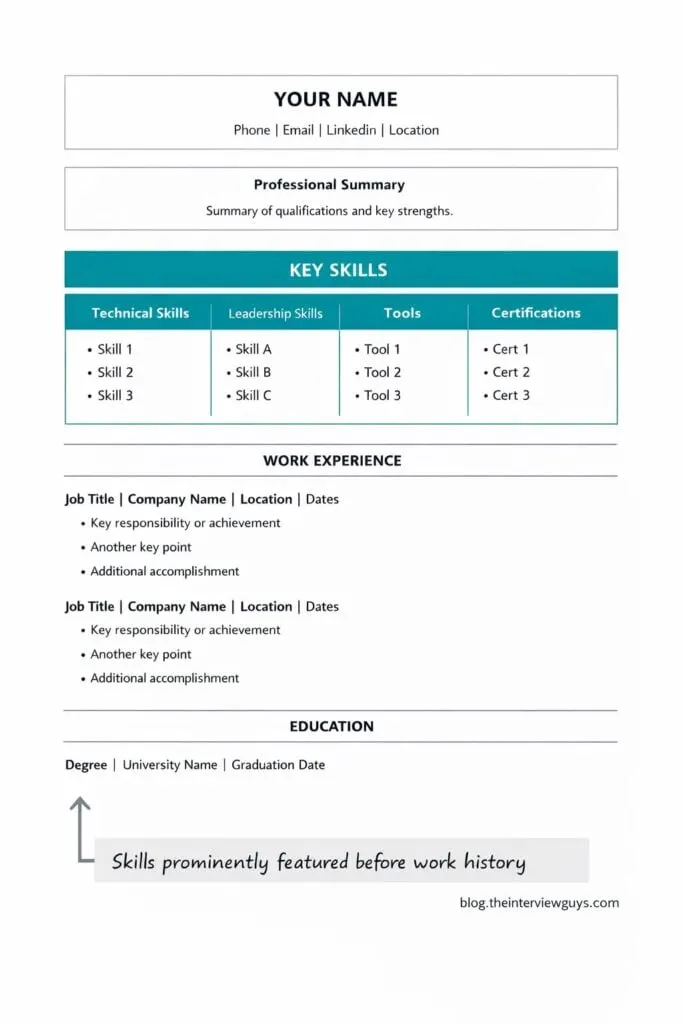
The 2026 skills-first structure looks like this:
- Contact Information
- Professional Summary
- Core Competencies / Skills
- Work Experience (chronological, with dated entries)
- Education
- Optional: Certifications, Projects, Volunteer Work
This order front-loads your keywords where ATS systems weight them most heavily (the first third of your document) while preserving the chronological work history that recruiters and hiring managers expect to see.
Step 2: Write a skills-anchored professional summary
Your summary is 3-4 lines. Drop the generic "results-driven professional with excellent communication skills." Instead, name your top capability, your domain, and one concrete result.
Weak: "Experienced marketing professional looking for new opportunities to leverage my skills."
Strong: "Digital marketing strategist with 6+ years building data-driven campaigns that increased customer engagement by 45% and generated $2M+ in annual revenue. Expert in SEO, paid media, and cross-functional team leadership."
The strong version does three things: it names a skill set, a domain, and proof. Hiring managers can immediately answer "is this person relevant?"
Step 3: Build your Core Competencies section
Create a "Core Competencies" or "Areas of Expertise" block immediately beneath your summary. Aim for 12-18 relevant skills organized into 4-6 logical categories that reflect your field. Don't create a wall of 30 keywords. That looks like keyword stuffing and reads as noise.
Example (Marketing):
| Category | Skills |
|---|---|
| Digital Strategy | SEO / Search Engine Optimization, Paid Media, Content Marketing |
| Analytics | Google Analytics, A/B Testing, Data Visualization |
| Tools | HubSpot, Salesforce, Tableau |
| Leadership | Cross-Functional Team Leadership, Stakeholder Management |
Two practical rules: (1) If a skill has a common abbreviation, include both, as in "SEO (Search Engine Optimization)," because ATS systems may search for either. (2) Mirror the exact language from the job posting wherever your skills genuinely match. ATS systems compare your resume to the job description algorithmically, so precision matters.
Step 4: Write achievement-driven work experience bullets
This is where skills-first resumes either win or fall apart. A list of skills tells a hiring manager what you know. Your bullets tell them what you can do, and that's what they're actually hiring for.
Each bullet should follow this structure: action verb, skill applied, measurable result.
Weak: "Responsible for managing social media accounts."
Strong: "Grew LinkedIn audience from 4,200 to 18,000 followers in 12 months by implementing a data-driven content calendar and A/B testing post formats, driving a 62% increase in inbound lead inquiries."
Aim for 3-5 bullets per role. Every bullet should connect a skill from your Core Competencies section to a real outcome. If you can't quantify something, qualify it by describing the scale, scope, or impact.
Step 5: Keep education lean (unless it's a differentiator)
In a skills-first format, education moves to the bottom, unless you're a recent graduate where it's your primary credential, or you hold an advanced degree that's directly relevant and competitive. List your degree, institution, and graduation year. That's it. Add GPA, relevant coursework, and honors only if they're strong and recent.
Step 6: Tailor for every application
A skills-first resume creates an easy tailoring workflow. Before each application: (1) Read the job description carefully. (2) Pull the 5-7 most emphasized skills and requirements. (3) Confirm each appears in your Core Competencies and/or work experience bullets. (4) Adjust your summary's opening line to reflect the specific role title.
This takes 15-20 minutes per application and can meaningfully improve your ATS match rate.
How this changes for different job seekers
Career changers
Your chronological history lists the wrong job titles. Lead with skills aggressively. Use your summary to name the role you're targeting and translate your transferable skills explicitly: "Former teacher transitioning to instructional design, with 8 years of curriculum development, stakeholder communication, and performance assessment." Your Core Competencies section should mirror the target field's language, not your previous industry's.
Recent graduates and entry-level candidates
You likely have more skills than job titles. Build your Core Competencies from internships, coursework, academic projects, certifications, and volunteer work. In your Work Experience section, include internships, relevant part-time roles, and even significant academic projects as entries. They count. A strong skills section backed by project-level proof outperforms a thin work history left to speak for itself.
Returning professionals
The gap is visible no matter what format you use, so own it briefly in your summary and let your skills section shift the focus. "Marketing strategist with 10+ years of experience returning to full-time practice after a three-year career break. Maintained expertise through freelance consulting and completed Google Analytics and HubSpot certifications in 2025-2026." Date your certifications to show continued engagement.
Freelancers and contractors
List your freelance work as a single entry, such as "Independent Consultant, 2021-Present," with client categories and outcomes in the bullets. Use your Core Competencies to bridge the gap between what you've done and what a full-time employer needs from you.
Common mistakes that undermine a skills-first resume
- Using the pure functional format and calling it skills-first. Fix: always include a dated work history. No dates means automatic suspicion from ATS and recruiters.
- Listing skills without proof. Fix: every skill in your Core Competencies section should appear in at least one work experience bullet with a result attached.
- Keyword-stuffing the skills section with 30+ terms. Fix: cap at 12-18 well-organized skills. Quality and relevance beat volume every time.
- Writing a generic summary that could apply to anyone. Fix: name your top skill, your domain, and one measurable result, every time, for every application.
- Forgetting to include abbreviation variants. Fix: write "SEO (Search Engine Optimization)" so ATS catches both the acronym and the full phrase.
- Never tailoring the skills section. Fix: cross-reference the job description before every submission and adjust your top 3-5 skills to match its exact language where honest.
Your free 2026 skills-first resume template
Copy this structure and fill in your own details. Replace all bracketed placeholders with your real information.
[YOUR FULL NAME] [City, State/Country] · [Phone] · [Email] · [LinkedIn URL] · [Portfolio URL if relevant]
PROFESSIONAL SUMMARY
[Job title you're targeting] with [X] years of experience in [core domain]. Proven track record of [top achievement with a number]. Expert in [Skill 1], [Skill 2], and [Skill 3].
CORE COMPETENCIES
| [Category 1] | [Category 2] | [Category 3] |
|---|---|---|
| Skill A · Skill B · Skill C | Skill D · Skill E · Skill F | Skill G · Skill H · Skill I |
(Add a 4th category row if needed for your field.)
WORK EXPERIENCE
[Most Recent Job Title] | [Company Name] | [City, Country] | [Month Year - Month Year or Present]
- [Action verb] + [skill applied] + [measurable result]
- [Action verb] + [skill applied] + [measurable result]
- [Action verb] + [skill applied] + [measurable result]
[Previous Job Title] | [Company Name] | [City, Country] | [Month Year - Month Year]
- [Action verb] + [skill applied] + [measurable result]
- [Action verb] + [skill applied] + [measurable result]
(Repeat for each relevant role. Go back 10-15 years max unless earlier roles are highly relevant.)
EDUCATION
[Degree Name] | [Institution Name] | [Graduation Year] [Optional: relevant honors, certifications, or specializations only if strong]
CERTIFICATIONS / PROFESSIONAL DEVELOPMENT (if applicable)
- [Certification Name] - [Issuing Body], [Year]
- [Certification Name] - [Issuing Body], [Year]
2026 skills-first resume checklist
Use this before you hit send:
- ✅ Contact information is complete and includes a LinkedIn URL
- ✅ Summary names a target role, a top skill, and one quantified result
- ✅ Core Competencies section has 12-18 skills in 4-6 categories
- ✅ Skills match the language used in the job description
- ✅ Abbreviations and full terms are both included (e.g., "PPC / Pay-Per-Click")
- ✅ Every role in Work Experience has at least 3 achievement-driven bullets
- ✅ Every bullet connects a skill to a measurable or qualified outcome
- ✅ All work history entries include company name, job title, and employment dates
- ✅ Education is listed at the bottom (unless you're a recent grad)
- ✅ Resume is saved as a .docx or ATS-compatible PDF (not a design-heavy file)
- ✅ Tailored for this specific job, with summary and top skills reflecting the job posting
Frequently asked questions
Is a skills-first resume the same as a functional resume? No, and this distinction matters. A functional resume hides or omits employment dates and organizes everything by function, which ATS systems struggle to parse and recruiters distrust. A skills-first resume puts your skills front and center but still includes a full, dated chronological work history. Think of it as a hybrid format with skills front-loaded. The pure functional format is largely obsolete in 2026.
Will a skills-first resume pass ATS screening? Yes, when built correctly. The key is keeping your work history intact with clear dates, job titles, and employer names, since those are the fields ATS systems are programmed to extract. Front-loading your skills section actually helps your ATS score because most platforms weight keywords that appear early in the document more heavily. Just make sure your skills mirror the exact language from the job description.
How many skills should I list on a skills-first resume? Aim for 12-18 skills organized into 4-6 categories. Fewer than 10 and you're leaving ATS match potential on the table; more than 20 and the section starts to look like keyword stuffing, which reads as noise to both algorithms and human reviewers. Every skill you list should appear in at least one work experience bullet with evidence behind it.
Should I use a skills-first resume if I have a strong career history? Not necessarily. If your job titles are recognizable, your progression is clear, and your most recent role is your strongest credential, a chronological resume with a strong skills section near the top is likely your best bet. The skills-first structure is most useful when your title history doesn't tell your full story. Career changers, returners, and freelancers benefit most.
How do I handle employment gaps in a skills-first resume? Don't try to hide gaps. Modern recruiters and ATS tools both look for them. Address a gap briefly and confidently in your summary ("returning after a three-year career break focused on caregiving"), then let your skills section shift attention to your capabilities. If you took courses, earned certifications, or did any freelance work during the gap, list those. The goal is to show continuity of learning or relevance, not to make the gap disappear.
Your resume is a positioning document, not a biography. The skills-first format lets you lead with your value before your history, and in 2026's hiring market, that order increasingly matters. Start with the template above, fill it with honest, specific proof, and tailor the skills section for every role you apply to. The right format, real evidence, and a targeted fit are what move your application from the pile to the interview.
Editor's Picks
 News
News AI Layoffs 2026: Real Data, Safe Jobs & How to Upskill Fast
Jul 3, 2026
 Skills
 AI Literacy or AI Engineering: Which Skill Pays Off in 2026?
Jul 3, 2026
 Resume
 AI Resume Writer 2026: Beat ATS & Get Hired Fast
Jul 3, 2026
 Skills
 AI Skills on Your 2026 Resume: Before & After Examples That Work
Jul 3, 2026