Telehealth Jobs 2026: Roles, Salaries & How to Get Hired Remotely
Explore in-demand telehealth jobs in 2026 — top roles, real salary ranges, required qualifications, and actionable tips to land a remote healthcare position.
Telehealth Jobs 2026: Roles, Salaries & How to Get Hired Remotely
Telehealth has quietly become one of the most reliable paths into a well-paying, fully remote healthcare career, and 2026 is the year the hiring market reflects that reality at scale.
Whether you're a clinician tired of the commute, a healthcare administrator eyeing a pivot, or a tech-savvy professional curious about virtual care, this guide gives you a clear picture of the roles that are hiring, what they pay, what employers actually want, and how to position yourself to get hired.
The telehealth industry in 2026: why this moment matters
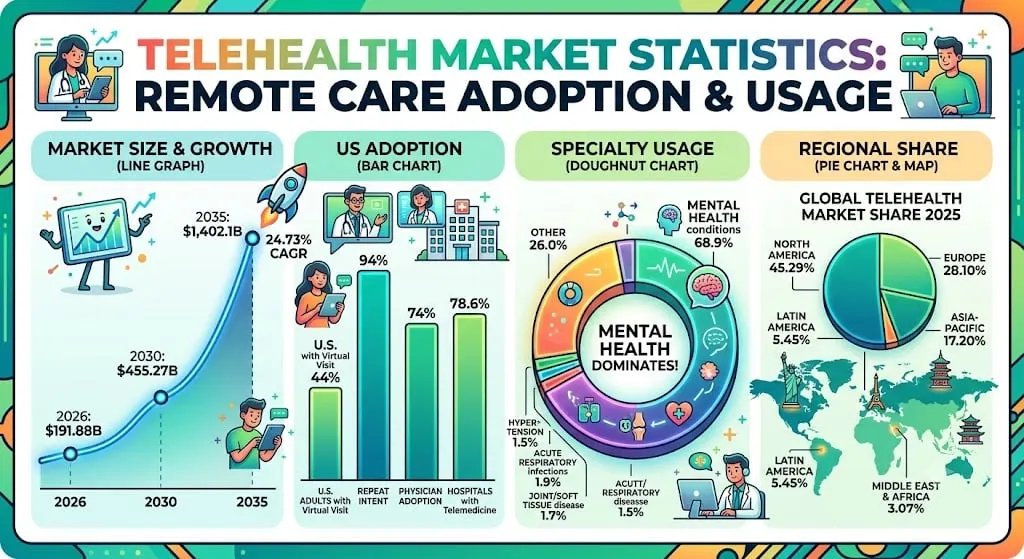
The numbers are hard to ignore. The global telehealth market hit $191.88 billion in 2026, up from $153.84 billion just a year earlier, and is projected to reach $1.4 trillion by 2035, growing at a compound annual rate of nearly 25%. In the United States alone, the market is valued at $65.35 billion this year, and there are now over 15,500 telehealth businesses operating domestically, a sector that has grown at a 42.2% CAGR since 2021.
What's fueling this? Mental health demand is the single biggest driver. Mental health services now account for 68.9% of all U.S. telehealth claim lines, 36 times more than the next-largest category (acute respiratory infections). Psychiatry is the fastest-growing and highest-revenue disease area in the entire segment. Cardiology, radiology, and chronic disease management are close behind.
For job seekers, the practical implication is clear: this isn't a niche or a trend. It's a structural shift in how healthcare is delivered, and the hiring is real, sustained, and geographically distributed. North America currently holds about 41% of global market share, but Asia-Pacific is growing fastest, making this a genuinely international opportunity for globally mobile professionals.
One important caveat: regulation remains the defining uncertainty. The U.S. still lacks permanent federal telehealth policy, and the "policy cliff" expected in late 2026 has the American Telemedicine Association pushing hard for stable, codified rules. The good news is that many Medicare telehealth flexibilities have already been extended through December 31, 2027, including expanded behavioral health access and broader geographic eligibility, giving employers a solid enough runway to keep hiring confidently.
Most in-demand telehealth roles right now

The field spans clinical and non-clinical work. Here are the roles seeing the strongest hiring demand in 2026:
- Telemedicine Physician, Conducts virtual patient consultations, diagnoses, and follow-ups; demand surges as organizations shift care delivery online to cut costs.
- Telehealth Nurse Practitioner (NP), Provides independent virtual care including prescribing; high demand given NP scope-of-practice expansions in many states.
- Telehealth Registered Nurse (RN), Handles patient triage, chronic condition monitoring, and care coordination via secure video and messaging platforms.
- Remote Patient Monitoring (RPM) Specialist, Manages data from wearables and connected devices to track patients between visits; a fast-growing role as CMS billing rules for RPM were clarified in 2026.
- Telehealth Coordinator, The operational backbone: schedules virtual visits, manages platforms, handles patient onboarding, and bridges clinical and tech teams.
- Behavioral Health Therapist / Telepsychiatrist, Delivers mental health therapy or psychiatric care remotely; the single hottest subspecialty given that mental health drives nearly 69% of all telehealth utilization.
- Telehealth Physical Therapist, Guides patients through rehabilitation remotely; companies like Luna Physical Therapy and Hinge Health are actively scaling these teams.
- Healthcare IT / Telehealth Platform Specialist, Implements, manages, and troubleshoots the technology infrastructure underpinning virtual care delivery.
Realistic salary ranges for telehealth roles
Here's where compensation lands in 2026 for the most common roles, anchored to current market data. Remote positions frequently match or exceed on-site equivalents, which is a genuine advantage of this sector.
| Role | Entry / 25th Percentile | Median / Average | Senior / 90th Percentile |
|---|---|---|---|
| Telemedicine Physician | $322,706 | $410,722 | $660,885 |
| Telehealth Nurse Practitioner | ~$120,000 | $165,094 | $185,426+ |
| Telehealth Registered Nurse | $76,921 | $91,359 | $128,420 |
| Remote Physical Therapist | $75,000 | ~$85,000 | $95,000 |
| PT Director (Telehealth) | $95,000 | ~$112,000 | $130,000 |
| Telehealth Coordinator | $51,185 | $64,365 | $100,360 |
| RPM / Healthcare IT Specialist | $55,000 | ~$75,000 | $110,000+ |
A few things worth noting. Telemedicine physicians are earning roughly 40% more than peers in traditional practice, partly because telehealth visits cost organizations around $380 compared to $493 for in-person care, and those savings get reinvested into competitive compensation. Geography still moves the needle for nurses: telehealth NPs in Chicago average $134,328, while top earners in high-cost markets pull $185,000+. For non-clinical roles like telehealth coordinator, the ceiling climbs quickly once you add platform-specific certifications or move into management.
Required qualifications & skills
Clinical roles: hard requirements
- ✅ Active, unrestricted state licensure in your discipline (MD, NP, RN, PT, LCSW, etc.)
- ✅ For nurses: Nurse Licensure Compact (NLC) membership, now covering 40+ states. This single license lets you practice across member states, which is a major career enabler for remote work.
- ✅ Board certification in your specialty (especially important for psychiatry, cardiology, and family medicine)
- ✅ DEA registration if prescribing controlled substances (requirements vary by state and substance)
- ✅ BLS/ACLS certification where required by employer
- ✅ 1 to 2 years of in-person clinical experience before most employers consider you for telehealth roles
Non-clinical / operational roles: hard requirements
- ✅ Bachelor's degree in healthcare administration, health informatics, IT, or a related field (preferred for most coordinator and IT roles)
- ✅ At least 1 year of experience in a healthcare setting
- ✅ Familiarity with EHR platforms (Epic, Cerner, or specialty-specific tools)
- ✅ HIPAA compliance training and certification
- ✅ For RPM specialist roles: experience with connected health devices and data platforms
The soft skills employers actually prioritize
Telehealth employers screen for a specific set of behavioral traits that differ meaningfully from traditional healthcare hiring. They want professionals who are comfortable building rapport through a screen, because therapeutic alliance and patient trust don't transfer automatically to a video format. Self-direction is non-negotiable: you're often working without a charge nurse or supervisor in the next room. Strong written communication matters too, since asynchronous messaging and documentation are core workflows. Finally, technical adaptability (the willingness to troubleshoot platforms, switch tools, and guide less tech-confident patients) consistently appears in job postings as a differentiator.
Hiring trends & forces reshaping telehealth in 2026
Three forces are actively reshaping how this industry hires.
🔵 Mental health is the hiring engine. With psychiatry and behavioral health dominating telehealth utilization, and demand still outpacing supply, behavioral health clinicians (therapists, psychiatrists, psychiatric NPs) are the most aggressively recruited professionals in the sector. If you hold these credentials, you have significant leverage in salary negotiations right now.
🔵 Remote Patient Monitoring is creating an entirely new job category. The 2026 CMS Physician Fee Schedule simplified RPM and RTM billing, making it easier for healthcare organizations to build out dedicated monitoring teams. Expect dedicated RPM coordinator, RPM nurse, and RPM data analyst roles to proliferate over the next 12 to 18 months.
🔵 Policy uncertainty is making employer caution a real factor. The lack of permanent federal telehealth legislation means some organizations are hiring on rolling contracts or part-time engagements rather than full-time permanent positions, especially for physicians. If you're evaluating offers, ask specifically about the company's plan if reimbursement rules shift post-2027. Organizations with diversified payer mixes (commercial, Medicare, and Medicaid) are generally safer bets.
Asia-Pacific markets are also opening up for internationally licensed clinicians, particularly in Australia, Singapore, and India, as regional telehealth infrastructure accelerates. If you hold international credentials, this is worth researching.
Industry-specific resume & interview tips
Generic healthcare resume advice won't cut it here. Telehealth employers have specific filters.
Lead with your licensure geography upfront. Put your active state licenses (and NLC compact status if applicable) in your resume header or summary, not buried in a credentials section. Hiring managers screen for this before reading anything else.
Name the platforms you've used. "Proficient in telehealth technology" means nothing. "Experienced with Doxy.me, Teladoc Health platform, and Epic's virtual care module" gets you past the ATS and signals real-world readiness. List platforms the same way a developer lists programming languages.
Quantify patient volume and outcomes. Weak: "Conducted telehealth appointments." Strong: "Managed 25 to 30 virtual patient visits daily via Zoom Health, achieving a 94% patient satisfaction score over 12 months." Numbers prove you can handle the workload and the format.
Address the remote-readiness question before they ask it. Add a brief line in your summary or a dedicated "Remote Work Setup" section confirming you have a HIPAA-compliant workspace, reliable high-speed internet, and a professional video background. This is a real screening criterion for clinical roles, and surfacing it proactively removes a common hesitation.
Prepare for competency-based interview questions specific to virtual care. Expect: "How do you build patient rapport in a video-only environment?" and "Walk me through how you handle a patient who is experiencing a crisis during a telehealth session." These aren't hypothetical warm-ups. They're core competency screens. Practice concrete, scenario-based answers.
Research the company's regulatory posture. Before any interview, look up whether the employer operates in compact-license states, what payers they accept, and whether they've publicly commented on the 2026 to 2027 policy cliff. Demonstrating this awareness in an interview signals that you understand the business, not just the clinical work, and that distinction gets you hired at the senior level.
Is this industry right for you?
| ✅ Great fit if you… | ⚠️ Think carefully if you… |
|---|---|
| Want genuine location independence: work from anywhere with good internet | Rely heavily on hands-on, in-person patient interaction for job satisfaction |
| Are comfortable with tech tools and willing to learn new platforms | Prefer a structured, on-site team environment with immediate supervisor access |
| Hold a compact or multi-state license (or are willing to pursue one) | Have only single-state licensure and aren't open to expanding it |
| Specialize in behavioral health, psychiatry, or chronic disease management | Work in a hands-on specialty (surgery, emergency medicine) with limited telehealth applicability |
| Want to avoid commuting, reduce burnout, and control your schedule | Are early in your clinical career and still need mentored, in-person skill-building |
| Are self-directed and productive without physical supervision | Find remote work isolating or struggle with self-managed workflows |
The honest truth: telehealth isn't right for every clinician, and it rewards those who genuinely prefer digital-first interaction. If you miss the energy of a busy floor or clinic, remote care can feel hollow quickly. But if the flexibility, the compensation premium, and the autonomy appeal to you, and your specialty translates, this is one of the strongest career moves available in healthcare right now.
Next steps to break in or level up
Ready to move? Here's your ordered action plan.
Audit and expand your licensure. If you're a nurse, apply for NLC compact licensure if your home state participates. It's the single highest-leverage credential action you can take this year. Physicians should research interstate compacts like the IMLC (Interstate Medical Licensure Compact), which now covers most U.S. states.
Get certified in telehealth delivery. The American Telemedicine Association offers recognized training. The Telehealth Certification Institute provides role-specific courses for clinicians and coordinators. These credentials signal commitment and show up well in ATS keyword scans.
Build your platform literacy. If you haven't used major telehealth platforms (Teladoc, Amwell, Doxy.me, MDLive, or Hinge Health), create a free or trial account and get familiar. For RPM roles, research companies like Withings Health Solutions and Current Health to understand the device ecosystem.
Target the right employers directly. Beyond job boards, build a target list of telehealth-native companies. Teladoc Health, Cerebral, Talkspace, Included Health, LifeStance Health, 98point6, Hinge Health, and Luna Physical Therapy are all actively scaling teams in 2026. Follow their careers pages and set up job alerts.
Rewrite your resume for telehealth-specific ATS. Work in keywords like "remote patient monitoring," "virtual care delivery," "HIPAA-compliant telehealth," "compact licensure," and your specific platform experience. Run your resume through a free ATS checker before submitting anywhere.
Join the community. The American Telemedicine Association (ATA) has an active member network and posts jobs directly. LinkedIn's Telehealth Professionals group and specialty-specific Slack communities (particularly in behavioral health) surface opportunities and insider intel that never make it to job boards.
The telehealth market is growing faster than it can fill its open roles. The professionals who land the best positions in 2026 aren't necessarily the most credentialed. They're the ones who understand the industry's unique dynamics, show up prepared, and make it easy for hiring managers to say yes. Start with step one today and you'll be ahead of most applicants before the week is out.
Editor's Picks
 News
News AI Layoffs 2026: Real Data, Safe Jobs & How to Upskill Fast
Jul 3, 2026
 Skills
 AI Literacy or AI Engineering: Which Skill Pays Off in 2026?
Jul 3, 2026
 Resume
 AI Resume Writer 2026: Beat ATS & Get Hired Fast
Jul 3, 2026
 Skills
 AI Skills on Your 2026 Resume: Before & After Examples That Work
Jul 3, 2026